
Undergoing a hair transplant is a big decision — not just financially, but emotionally. One of the most common questions patients ask is: “How long does it take to see results?”
Understanding the hair transplant timeline helps you set realistic expectations, reduce anxiety, and follow the right aftercare steps. From your initial consultation to seeing full hair growth, the journey typically spans 12–18 months.
Let’s break down every stage in detail.
Understanding the Hair Transplant Timeline
The hair transplant timeline refers to the complete process from consultation, surgery day, recovery phase, shedding period, and finally achieving full hair density. While techniques like FUE (Follicular Unit Extraction) and DHI (Direct Hair Implantation) offer faster healing compared to FUT, the biological hair growth cycle still determines when visible results appear.
Hair grows in natural cycles:
- Anagen (growth phase)
- Catagen (transition phase)
- Telogen (resting/shedding phase)
Because transplanted grafts follow this cycle, patience is essential.
Stage 1: Initial Consultation (Week 0)
The journey begins with a detailed consultation at a certified hair restoration clinic.
During this stage, the surgeon will:
- Assess your scalp condition and donor area
- Evaluate hair density and hairline design
- Identify the cause of hair loss (often androgenetic alopecia)
- Discuss medical history
- Estimate the number of grafts required
Clinics may use digital scalp analysis tools to calculate graft survival rates and predict coverage.
This step ensures you are a suitable candidate and helps create a personalized treatment plan.
Stage 2: Pre-Procedure Preparation (1–2 Weeks Before Surgery)
Once surgery is scheduled, patients receive preparation guidelines:
- Avoid smoking and alcohol
- Stop certain medications (if advised)
- Avoid blood-thinning supplements
- Wash hair with prescribed shampoo
- Arrange post-surgery transport
Proper preparation improves graft survival and minimizes complications.
Stage 3: Surgery Day (Day 1)
On the day of your procedure:
- Local anesthesia is administered
- Grafts are extracted from the donor area
- Follicles are implanted into the recipient area
Depending on graft count (e.g., 2,000–4,000 grafts), the procedure may take 6–8 hours.
You’ll leave the clinic the same day with aftercare instructions and medication.
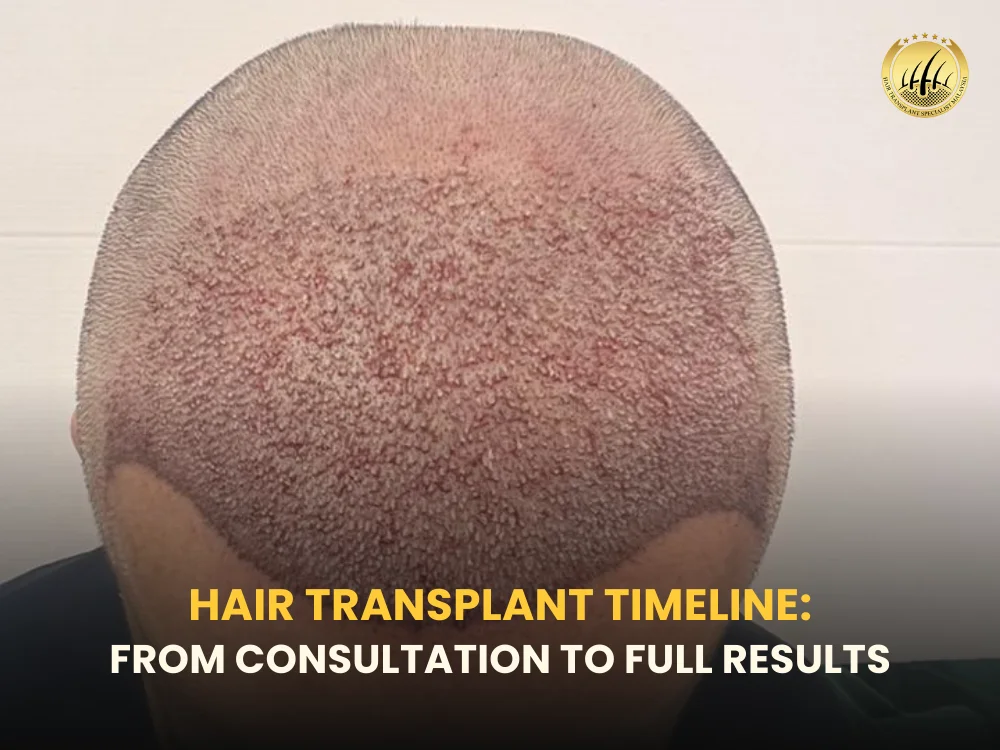
Stage 4: Immediate Recovery (Days 1–7)
This phase focuses on healing.
What to expect:
- Mild swelling
- Redness
- Tiny scabs around grafts
- Tightness in donor area
By Day 3–5:
- Swelling usually subsides
- Scabs begin forming
By Day 7–10:
- Scabs naturally fall off
- Most visible signs of surgery disappear
It’s critical not to scratch or rub the scalp during this period.
Stage 5: Shedding Phase (Weeks 2–8)
This stage surprises many patients.
Around 2–4 weeks after surgery, transplanted hairs begin to fall out. This is called shock loss.
Important to remember:
- Shedding is normal
- Hair follicles remain intact
- It signals the start of a new growth cycle
This is part of the natural hair transplant timeline and does not mean failure.
Stage 6: Dormant Phase (Months 2–3)
After shedding, the scalp may look similar to pre-surgery.
This “quiet phase” can feel discouraging, but beneath the skin:
- Follicles are adapting
- Blood supply is stabilizing
- Roots prepare for new growth
Patience is key during this stage.
Stage 7: Early Growth Phase (Months 3–4)
New hair begins to emerge.
Initially, hair appears:
- Thin
- Soft
- Uneven
This is completely normal. Early growth may look patchy.
Approximately 10–20% of final results are visible by month four.
Stage 8: Noticeable Improvement (Months 5–6)
At this stage:
- Hair becomes thicker
- Density increases
- Hairline shape becomes clearer
Around 40–50% of final results are visible.
Most patients feel significantly more confident during this period.
Stage 9: Major Growth Phase (Months 7–9)
This is when transformation becomes obvious.
You may notice:
- Substantial density improvement
- Better styling ability
- Natural blending with existing hair
About 70–80% of final growth is achieved by month nine.
Hair texture also improves during this stage.
Stage 10: Full Results (Months 12–18)
Final results are typically visible between 12 and 18 months.
At this point:
- Hair reaches full thickness
- Density stabilizes
- Natural growth cycle is established
- Final hairline is fully defined
Crown areas sometimes take longer (up to 15–18 months) compared to frontal hairline.
Factors That Influence the Hair Transplant Timeline
Not all patients follow the exact same schedule. Several variables affect progress:
1. Technique Used
DHI and FUE usually allow faster recovery than FUT.
2. Number of Grafts
Higher graft counts may require longer healing.
3. Individual Healing Capacity
Age, genetics, and health impact recovery speed.
4. Aftercare Compliance
Following post-operative instructions improves graft survival.
5. Smoking & Lifestyle
Smoking reduces blood circulation, delaying growth.
Hair Transplant Timeline Comparison: FUE vs DHI vs FUT
Stage | FUE | DHI | FUT |
Healing Time | 7–10 days | 7–10 days | 10–14 days |
Scarring | Minimal | Minimal | Linear scar |
Early Growth | 3–4 months | 3–4 months | 3–4 months |
Full Results | 12–15 months | 12–15 months | 12–18 months |
Regardless of technique, the biological growth cycle remains similar.
Emotional Journey During the Hair Transplant Timeline
Hair restoration isn’t just a physical transformation — it’s a psychological journey. Understanding the emotional ups and downs that commonly occur after a hair transplant can help patients stay calm, confident, and patient throughout the process.
Because results develop gradually, your emotions may change at different stages of the hair transplant timeline.
Excitement after surgery
Right after the procedure, many patients feel hopeful and energized. Seeing the newly implanted grafts can create a strong sense of optimism. You’ve taken action to address hair loss, and that alone often boosts confidence.
Anxiety during the shedding phase
Around weeks 2–6, transplanted hairs typically enter a temporary shedding phase (often called “shock loss”). This is completely normal, but it can be emotionally challenging. Patients sometimes worry that the procedure didn’t work — even though shedding is a necessary part of the growth cycle.
Impatience at 3 months
By month three, visible growth is still minimal for most people. This is when impatience often peaks. It may feel like progress is slow, but beneath the surface, follicles are actively transitioning into the growth phase.
Satisfaction at 6 months
Around the six-month mark, noticeable improvement usually begins. Hair starts to look fuller, and styling becomes easier. This stage often restores confidence and reassures patients that the procedure is working as expected.
Confidence at 12 months
By one year, most patients see the final or near-final results. Density improves, hair thickens, and the new hairline looks natural. At this point, many people report feeling more self-assured in both personal and professional settings.
Tips to Optimize Your Results
Getting a hair transplant is only the first step. What you do during recovery plays a major role in graft survival, hair transplant timeline, and overall density. Following your surgeon’s instructions carefully can significantly improve your long-term outcome.
To support healthy regrowth:
Sleep with your head elevated during the first week
Keeping your head slightly elevated (using two pillows or a recliner) helps reduce swelling around the forehead and transplanted area. Minimizing swelling protects newly implanted grafts and promotes better healing in the early days.
Use only prescribed or approved shampoos
Your clinic will usually recommend a gentle, medical-grade shampoo. Avoid regular commercial hair products during early recovery, as harsh chemicals can irritate the scalp and affect graft stability. Wash your hair exactly as instructed to avoid dislodging grafts.
Avoid heavy exercise for 2–3 weeks
Strenuous workouts increase blood pressure and sweating, which may interfere with healing. Activities like weightlifting, running, football, or gym training should be postponed. Light walking is generally acceptable after a few days, depending on your surgeon’s advice.
Attend all follow-up appointments
Follow-up visits allow your doctor to monitor healing progress, identify any early concerns, and guide you through each stage of recovery. Skipping appointments may delay the management of minor issues that are easier to treat early.
Maintain balanced nutrition
Hair growth depends heavily on proper nutrition. Focus on:
Protein (eggs, fish, chicken, legumes)
Iron (leafy greens, red meat, beans)
Biotin and B-vitamins
Zinc and Vitamin D
Hydration is equally important. A well-nourished body supports stronger, thicker regrowth.
Consider PRP therapy if recommended
Platelet-Rich Plasma (PRP) therapy can enhance healing and stimulate hair follicles. Some clinics recommend PRP sessions after transplantation to support faster recovery and improve hair thickness over time.
Why Consistency Matters
Hair growth after a transplant follows a natural cycle, including the temporary shedding phase before new growth begins. Being consistent with aftercare, nutrition, and medical advice helps maximize graft survival and improve final density.
Remember, results typically develop gradually over 6–12 months. Patience, proper care, and consistency are key to achieving fuller, natural-looking hair.
Frequently Asked Questions (FAQs)
1. How long does a hair transplant timeline take to fully grow?
Full results typically appear between 12–18 months.
2. Is shedding after hair transplant timeline normal?
Yes. Shock loss occurs within 2–8 weeks and is temporary.
3. When can I cut my transplanted hair?
Usually after 1 month, but follow your surgeon’s advice.
4. When can I return to work?
Most patients return within 3–5 days, depending on job type.
5. Does transplanted hair grow permanently?
Yes. Donor hair is genetically resistant to DHT.
6. Why does growth look uneven at first?
Hair follicles enter the growth phase at different times.
7. Can I speed up the hair transplant timeline?
You can’t change biology, but proper care improves outcomes.
8. When will redness disappear?
Usually within 1–3 weeks, depending on skin sensitivity.
9. Does the crown area take longer to grow?
Yes, crown growth often takes up to 18 months.
10. What happens if I don’t see growth at 6 months?
Partial growth is normal. Full density takes up to a year.
Final Thoughts
The hair transplant timeline requires patience, but the long-term results are worth the wait. While early stages may feel slow, consistent progress typically becomes visible around month four and significantly improves by month nine.
Understanding each stage — from consultation to full density — helps you stay confident throughout the journey. With proper technique, experienced surgeons, and good aftercare, hair restoration delivers natural and lasting results.
If you’re considering treatment, consult a certified clinic to receive a personalized growth projection based on your scalp condition and goals.