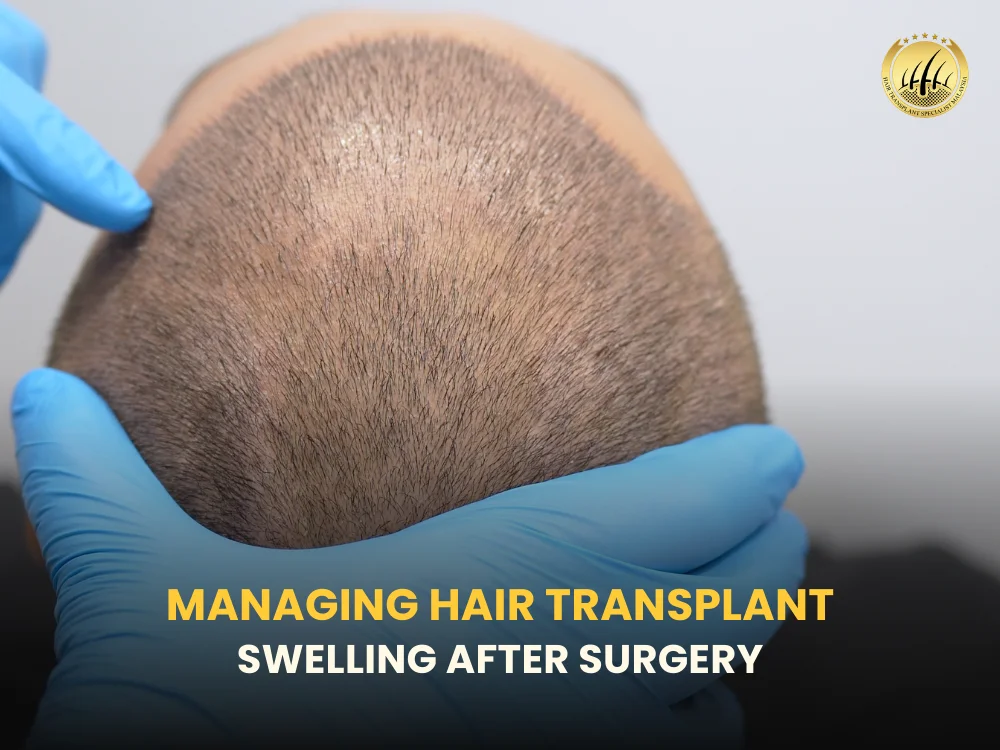
Hair transplant swelling is one of the most common and temporary side effects after a procedure. While it can look alarming—especially when it moves from the scalp to the forehead or around the eyes—it is usually a normal part of healing.
Whether you underwent Follicular Unit Extraction (FUE) or Follicular Unit Transplantation (FUT), understanding why Hair Transplant swelling happens and how to manage it can make your recovery smoother and less stressful.
In this guide, we’ll break down what causes post-transplant swelling, how long it lasts, how to reduce it safely, and when you should be concerned.
What Is Hair Transplant Swelling?
Hair transplant swelling refers to temporary fluid accumulation in the forehead and surrounding areas after surgery. It typically occurs 2–4 days after the procedure and may gradually move downward due to gravity.
During surgery, saline solution and local anesthesia are injected into the scalp. This fluid helps separate tissues and protect grafts, but afterward, some of it may shift into nearby areas, causing visible puffiness.
The good news? It is temporary and part of the body’s natural inflammatory response.
Why Does Hair Transplant Swelling Happen After?
Hair Transplant Swelling after hair restoration occurs mainly due to:
1. Fluid Injection During Surgery
Large volumes of tumescent fluid are injected into the scalp to create space for graft placement. Some of this fluid later migrates downward.
2. Inflammatory Healing Response
Your body naturally sends inflammatory cells to repair tiny surgical incisions.
3. Gravity
Swelling may move from the scalp to the forehead and sometimes around the eyes.
4. Surgical Technique
Both Follicular Unit Extraction and Follicular Unit Transplantation can cause swelling, although FUE patients often experience slightly more forehead swelling due to fluid distribution.
When Does Hair Transplant Swelling Start and How Long Does It Last?
Here’s a typical timeline:
- Day 0–1: Minimal swelling
- Day 2–3: Swelling begins
- Day 3–4: Peak swelling
- Day 5–7: Gradual resolution
Most patients see significant improvement within one week. In rare cases, mild puffiness may last up to 10 days.
Where Does Hair Transplant Swelling Appear?
Swelling doesn’t usually stay confined to the scalp. It can move downward and affect:
- Forehead
- Eyelids
- Upper nose bridge
This can temporarily change facial appearance, but it does not affect the transplanted grafts.
How to Reduce Hair Transplant Swelling Safely
Managing swelling properly can improve comfort and speed up recovery.
1. Sleep With Your Head Elevated
Use two or three pillows or sleep in a recliner at a 30–45° angle for at least 3–5 nights.
2. Take Prescribed Medications
Your surgeon may prescribe anti-inflammatory medication or steroids to minimize swelling.
3. Avoid Strenuous Activity
Heavy exercise increases blood flow and can worsen swelling.
4. Stay Hydrated
Proper hydration supports circulation and healing.
5. Use Cold Compress (Correctly)
Apply cold compresses on the forehead—not on the grafted area—for short intervals during the first 48 hours.
Always follow your clinic’s specific aftercare instructions.
What NOT to Do After a Hair Transplant Swelling
To prevent worsening swelling:
- ❌ Do not bend forward frequently
- ❌ Avoid alcohol in the first few days
- ❌ Do not massage the transplanted area
- ❌ Avoid excessive sun exposure
Following proper post-operative care protects both graft survival and overall recovery.
Is Hair Transplant Swelling a Sign of Complications?
In most cases, no. Mild to moderate swelling is completely normal.
However, contact your clinic if you notice:
- Severe pain
- Increasing redness
- Fever
- Pus or unusual discharge
- Swelling lasting beyond 10 days
These could indicate infection or abnormal inflammation, which requires medical review.
Does Hair Transplant Swelling Affect Hair Graft Survival?
No — postoperative swelling does not damage hair grafts.
After a hair transplant procedure such as Follicular Unit Extraction (FUE) or Follicular Unit Transplantation (hair transplant method (FUT), mild swelling is a normal inflammatory response. It typically occurs in the forehead area due to fluid used during surgery and the body’s natural healing process.
Why Swelling Does NOT Harm Grafts
Hair grafts are:
Carefully inserted into tiny, custom-made recipient sites
Anchored securely within the scalp tissue
Stabilized within the first 48–72 hours
Swelling happens in the surrounding soft tissue — not inside the graft itself. The fluid accumulation does not “push out” or loosen transplanted follicles.
By the time visible swelling appears (often Day 2–3), the grafts are already settling into place.
When Can Grafts Be at Risk?
Graft survival is more likely to be affected by:
Rubbing or scratching the scalp
Accidental trauma (bumping the head)
Picking at scabs
Ignoring post-operative washing instructions
As long as you follow your surgeon’s aftercare guidance and avoid touching the transplanted area unnecessarily, swelling alone will not compromise your results.
Can Hair Transplant Swelling Be Prevented Completely?
Not entirely. But experienced surgeons minimize it by:
- Using controlled fluid injection techniques
- Prescribing preventive steroids
- Advising proper sleeping positions
Clinics affiliated with organizations like the International Society of Hair Restoration Surgery emphasize evidence-based aftercare to reduce post-operative side effects.
Comparing Hair Transplant Swelling in FUE vs FUT
While both methods can cause swelling, there are slight differences:
- FUE: More diffuse swelling due to widespread micro-incisions
- FUT: May have tighter sensation at donor strip site
Ultimately, swelling severity depends more on individual healing response than technique alone.
Emotional Impact of Temporary Hair Transplant Swelling
Let’s be honest—seeing your face swollen after surgery can feel unsettling. Some patients worry something went wrong.
But remember:
- It peaks quickly
- It resolves naturally
- It does not affect final results
Hair restoration is a process. Swelling is simply a short chapter in a long-term transformation.
Full Recovery Timeline After Hair Transplant
Understanding the full recovery journey helps set realistic expectations after a hair transplant procedure such as Follicular Unit Extraction (FUE) or Follicular Unit Transplantation (FUT). While swelling is temporary, the entire growth cycle takes time. Here’s what most patients can expect:
Week 1: Swelling and Scabs Resolve
During the first few days, mild swelling around the forehead and eyes may occur. This is completely normal and usually subsides within 3–5 days.
By the end of Week 1:
Scabs around the transplanted grafts begin to fall off
Redness gradually improves
The donor area starts healing comfortably
Proper washing and aftercare during this period are crucial to protect the grafts.
Week 2–4: Shock Loss May Occur
This stage can be emotionally challenging. The transplanted hairs often shed — a process known as “shock loss.”
Important to remember:
Only the hair shafts fall out
The follicles remain intact under the scalp
This is a temporary and expected phase
The scalp may look similar to pre-transplant condition, but internal healing continues.
Month 3–4: Early Growth Phase
Tiny new hairs begin emerging from the transplanted follicles. At this point:
Growth may appear thin or uneven
Texture can be slightly different initially
Results are still in early development
Patience is essential here, as visible cosmetic improvement is just beginning.
Month 6–9: Visible Density Improvement
This is when most patients feel excited about their decision.
During this phase:
Hair becomes thicker and stronger
Density significantly improves
Styling becomes easier
The hairline looks more natural
Around Month 8 or 9, many patients see about 60–80% of their final result.
Month 12: Final Results
By one year:
Full maturation of transplanted hair is typically achieved
Hair strands thicken to their natural diameter
The final density and hairline design are visible
For some individuals, especially crown areas, continued refinement may occur up to 15–18 months.
Why Patience Is Key
Hair grows in cycles. After transplantation, follicles need time to:
Recover from surgical stress
Enter the resting phase
Restart active growth
Rushing expectations can lead to unnecessary anxiety. Consistent follow-ups with your surgeon and proper scalp care ensure the best long-term outcome.
Hair restoration is a gradual transformation — but when done correctly, the results are long-lasting and natural.
Frequently Asked Questions (FAQs)
1. How common is hair transplant swelling?
Very common. Most patients experience mild to moderate swelling within the first few days.
2. Is forehead swelling normal after FUE?
Yes, especially around Day 3–4 due to fluid migration.
3. Can I use ice packs directly on my scalp?
No. Apply cold compress only to the forehead area, not on grafts.
4. Does swelling mean the procedure failed?
No. It is a normal inflammatory response and unrelated to graft survival.
5. When can I return to work?
Many patients return within 3–5 days, depending on swelling visibility and comfort.
6. Can sleeping flat worsen swelling?
Yes. Keeping your head elevated reduces fluid accumulation.
7. Should I massage swollen areas?
No. Avoid pressure or massage near transplanted zones.
8. Can dehydration worsen swelling?
Yes. Staying hydrated supports circulation and healing.
9. What medications help reduce swelling?
Doctors may prescribe short-term anti-inflammatory medication or oral steroids.
10. When should I worry about swelling?
If it lasts beyond 10 days or is accompanied by pain, redness, or fever.
Final Thoughts
Hair transplant swelling is temporary, predictable, and manageable. While it may look dramatic for a few days, it is part of normal healing.
By following proper aftercare, staying patient, and maintaining realistic expectations, you can ensure a smoother recovery journey.
If you’re planning a procedure or currently recovering, always communicate openly with your surgeon and follow medical advice carefully. Hair restoration is not just about the final result—it’s also about understanding the recovery process along the way.