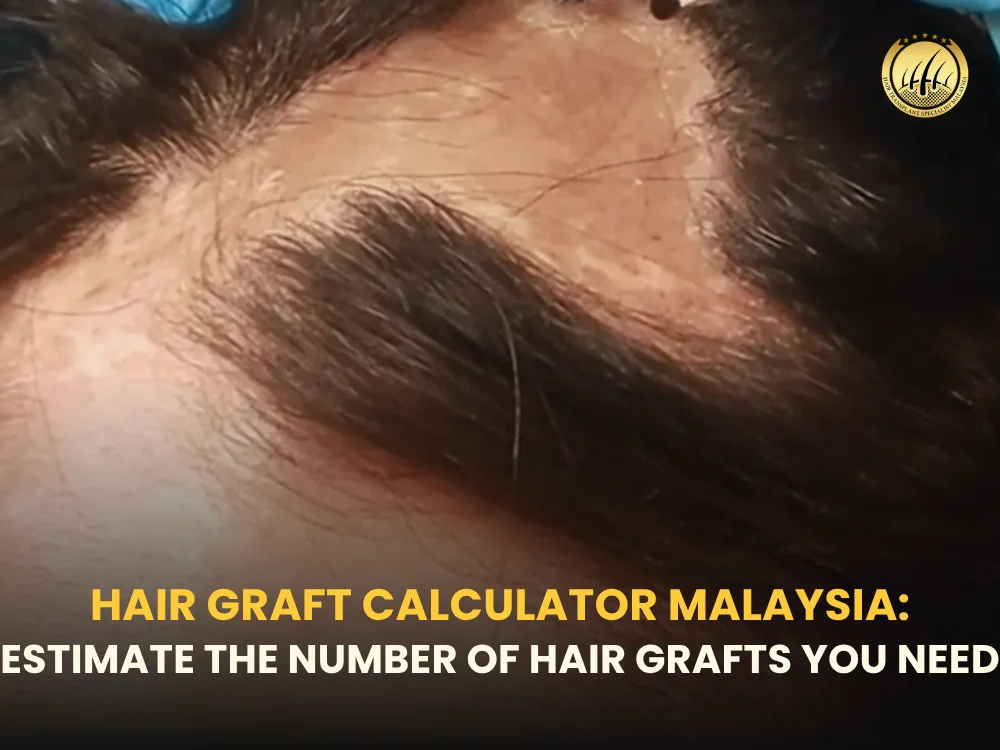
A hair graft calculator is an estimation tool that helps determine how many hair grafts may be required for a hair transplant based on the size of the balding area, current hair loss pattern, and desired hair density. It provides a useful starting point for planning a hair restoration procedure, although a professional assessment is needed for an accurate treatment plan.
Hair Graft Calculator Malaysia
A hair graft calculator helps individuals estimate the number of follicular unit grafts required to restore thinning or bald areas. Whether you are experiencing a receding hairline, frontal thinning, crown balding, or extensive hair loss, this tool offers a quick estimate before consultation.
Select Your Hair Loss Area
The first step is identifying the area affected by hair loss.
Common treatment areas include:
- Receding hairline
- Frontal scalp
- Mid-scalp
- Crown (vertex)
- Full scalp restoration
Different areas require different graft numbers because each region has unique density and coverage requirements.
Choose Your Desired Hair Density
Hair density refers to the number of grafts placed per square centimeter (cm²).
Typical density goals include:
| Density Level | Grafts per cm² | Appearance |
|---|---|---|
| Low | 25–30 | Basic coverage |
| Medium | 35–45 | Natural appearance |
| High | 45–60+ | Dense appearance |
Most modern FUE and FUT hair transplant procedures target 35–50 grafts/cm² for natural-looking results.
Get Your Estimated Graft Requirement
After selecting the treatment area and density target, the calculator estimates:
- Total grafts needed
- Estimated number of hairs transplanted
- Expected coverage area
- Potential treatment sessions
These estimates provide a planning guide before a comprehensive scalp examination.
What Is a Hair Graft Calculator?
A hair graft calculator is a digital assessment tool used to estimate the number of follicular units required to restore hair in thinning or bald areas.
A graft is a naturally occurring group of hair follicles extracted from the donor area, usually the back and sides of the scalp.
According to the International Society of Hair Restoration Surgery (ISHRS), modern hair transplantation focuses on transplanting naturally occurring follicular units to achieve realistic and long-lasting outcomes.
Hair graft calculators are commonly used by:
- Men with male pattern baldness
- Women with hair thinning
- Individuals planning FUE or FUT procedures
- Patients comparing treatment options
How a Hair Graft Calculator Works
The calculator combines several variables to estimate graft requirements.
Hair Loss Area Assessment
The first step evaluates where hair loss is occurring.
Areas commonly assessed include:
- Hairline recession
- Temple recession
- Frontal thinning
- Crown baldness
- Diffuse thinning
The larger the affected area, the more grafts are required.
Balding Area Size Calculation
The size of the balding area is measured in square centimeters.
For example:
- Small hairline zone: 20–30 cm²
- Frontal area: 40–60 cm²
- Crown area: 50–80 cm²
- Extensive loss: 100+ cm²
Accurate area measurement significantly improves graft estimates.
Hair Density Estimation
Density determines how many grafts are placed within a given area.
Factors affecting density include:
- Existing native hair
- Hair shaft thickness
- Hair color contrast
- Styling goals
Patients with thick hair often require fewer grafts to achieve visual coverage.
Graft Requirement Calculation
A simplified formula is:
Bald Area (cm²) × Desired Density (grafts/cm²) = Estimated Grafts Needed
Example:
50 cm² × 40 grafts/cm² = 2,000 grafts
This formula provides a practical estimate but does not replace a clinical assessment.
How Many Hair Grafts Do I Need?
The required graft count depends on the extent of hair loss and treatment goals.
Hairline Restoration Graft Calculator
Hairline restoration typically requires:
- Mild recession: 800–1,200 grafts
- Moderate recession: 1,200–1,800 grafts
- Advanced recession: 1,800–2,500 grafts
A natural hairline design is essential for long-term aesthetic results.
Frontal Area Graft Calculator
Frontal restoration generally requires:
- Light thinning: 1,000–1,500 grafts
- Moderate thinning: 1,500–2,500 grafts
- Significant loss: 2,500–3,500 grafts
The frontal scalp is usually prioritized because it frames the face.
Crown Area Graft Calculator
The crown often requires:
- Small crown: 800–1,500 grafts
- Medium crown: 1,500–2,500 grafts
- Large crown: 2,500–3,500 grafts
Crown restoration may require more grafts due to the natural swirl pattern.
Full Scalp Graft Calculator
Extensive restoration may require:
- 3,500–5,000 grafts
- 5,000–7,000+ grafts in severe cases
Large procedures may be completed over multiple sessions depending on donor availability.
Hair Graft Requirements by Hair Loss Stage
The Norwood Scale by DermNet is widely used to classify male pattern baldness.
Norwood 2 Hair Graft Estimate
- Minor hairline recession
- Approximately 800–1,500 grafts
Norwood 3 Hair Graft Estimate
- Deeper temporal recession
- Approximately 1,500–2,500 grafts
Norwood 4 Hair Graft Estimate
- Frontal and crown thinning
- Approximately 2,500–3,500 grafts
Norwood 5 Hair Graft Estimate
- Larger balding areas
- Approximately 3,500–4,500 grafts
Norwood 6 Hair Graft Estimate
- Extensive scalp involvement
- Approximately 4,500–6,000 grafts
Norwood 7 Hair Graft Estimate
- Advanced baldness
- Approximately 6,000–8,000+ grafts
Actual graft numbers vary depending on donor capacity and treatment goals.
Hair Graft Coverage Chart
The following estimates assume average hair characteristics and medium density placement.
500 Hair Grafts Coverage
Suitable for:
- Scar correction
- Minor temple recession
- Small touch-up procedures
Coverage: approximately 10–15 cm²
1,000 Hair Grafts Coverage
Suitable for:
- Early hairline restoration
- Small frontal zones
Coverage: approximately 20–30 cm²
1,500 Hair Grafts Coverage
Suitable for:
- Moderate hairline reconstruction
- Frontal reinforcement
Coverage: approximately 30–40 cm²
2,000 Hair Grafts Coverage
Suitable for:
- Frontal restoration
- Small crown treatments
Coverage: approximately 40–55 cm²
3,000 Hair Grafts Coverage
Suitable for:
- Combined frontal and crown treatment
- Moderate Norwood stages
Coverage: approximately 60–80 cm²
4,000 Hair Grafts Coverage
Suitable for:
- Extensive restoration
- Advanced hair loss
Coverage: approximately 80–100+ cm²
Hair Graft Density Guide
Hair density significantly affects the final visual result.
Low Density Coverage
25–30 grafts/cm²
Best for:
- Large treatment areas
- Budget-conscious restoration
- Basic cosmetic improvement
Medium Density Coverage
35–45 grafts/cm²
Best for:
- Natural appearance
- Balanced coverage
- Most hair transplant candidates
High Density Coverage
45–60+ grafts/cm²
Best for:
- Hairline refinement
- Maximum density goals
- Patients with strong donor reserves
Factors That Affect Hair Graft Calculation
Several variables influence the final graft count.
Extent of Hair Loss
More advanced hair loss requires greater graft numbers and donor planning.
Size of the Bald Area
Larger areas naturally require more grafts for adequate coverage.
Hair Characteristics
Important factors include:
- Hair thickness
- Curl pattern
- Hair color
- Skin-to-hair contrast
Patients with thick, curly hair often achieve greater visual density using fewer grafts.
Desired Hair Density
Higher density targets require more grafts and a larger donor supply.
Hair Graft Calculator Results Explained
Understanding the results helps set realistic expectations.
Estimated Number of Grafts
This figure represents the follicular units likely required for treatment.
Estimated Number of Hairs
Each graft contains approximately:
- 1–4 hairs
- Average: 2–2.5 hairs per graft
According to the American Hair Loss Association, follicular units naturally contain varying numbers of hairs, which influences transplant density.
Expected Coverage Area
Coverage estimates depend on:
- Graft count
- Density goals
- Existing hair
- Hair characteristics
Professional assessment remains essential for accurate planning.
Clinical Experience
In clinical hair restoration practice, graft estimates often differ from online calculations because donor quality, scalp flexibility, miniaturized hairs, and long-term hair loss progression must be considered. Patients frequently focus on maximizing graft numbers, but successful outcomes depend more on strategic graft placement and preserving donor reserves for future needs. Comprehensive scalp analysis using dermoscopy and donor density assessment provides the most reliable treatment plan.
For evidence-based information on hair loss diagnosis and treatment, patients can review resources from the American Academy of Dermatology (AAD) and the National Center for Biotechnology Information (NCBI).
Frequently Asked Questions
How accurate is a hair graft calculator?
A hair graft calculator provides a useful estimate based on treatment area size and density goals. Actual graft requirements may differ after a professional scalp and donor assessment.
How many hair grafts do I need?
Most patients require between 1,500 and 4,000 grafts, depending on the severity of hair loss, treatment area, and desired density.
How many hairs are in one graft?
A single graft typically contains 1–4 hairs, with an average of 2–2.5 hairs per graft.
Is 2,000 grafts enough?
Yes. For many patients, 2,000 grafts can effectively restore a receding hairline, frontal thinning, or a small crown area.
Is 3,000 grafts enough?
Yes. Approximately 3,000 grafts can provide substantial frontal and crown coverage for moderate hair loss cases.
What is the maximum number of grafts in one session?
Modern FUE mega sessions may transplant 3,000–5,000 grafts or more in carefully selected candidates. The safe maximum depends on donor availability, scalp characteristics, and surgical planning.
Consult Hair Transplant Malaysia Clinic
A hair graft calculator is an excellent starting point, but the most accurate estimate comes from a detailed scalp and donor assessment. If you are considering a hair transplant, consult the specialists at Hair Transplant Malaysia Clinic for a personalized graft calculation, hair loss evaluation, and customized treatment plan based on your unique hair characteristics and long-term restoration goals.
Book a consultation today to receive a professional assessment and discover how many grafts you may need for natural-looking, lasting results.