Eyebrow Hair Transplant in Kuala Lumpur
Get Thicker Eyebrow With Eyebrow Hair Transplant in Malaysia
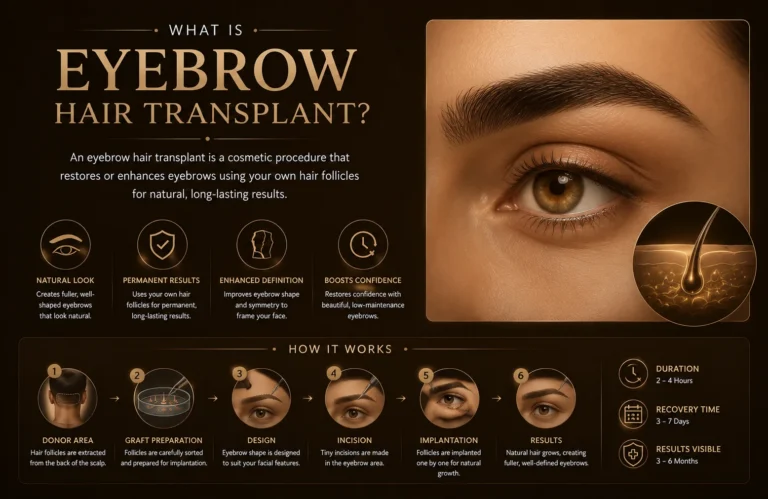
An eyebrow hair transplant is a permanent cosmetic procedure that harvests healthy, individual hair follicles from a donor area (usually the back of the scalp) and strategically implants them into the brow region. This minor surgical treatment successfully reconstructs, thickens, and reshapes thinning, patchy, or entirely missing eyebrows with natural, lifelong hair growth.
What Is Eyebrow Hair Transplant?
An eyebrow hair transplant is a specialized forms of hair restoration surgery designed to redefine your facial symmetry. Over-plucking, genetics, physical trauma, scarring, or underlying medical conditions like alopecia can leave eyebrows looking patchy and thin.
During this microscopic procedure, a certified hair transplant doctor extracts single hair grafts from a donor site (where the hair is finest) and meticulously places them into the brow area. Because the moved hair retains its original characteristics, it will continue to grow naturally in its new position, requiring occasional trimming just like normal head hair.
Benefits of Eyebrow Hair Treatment
Lifetime Permanent Results
Unlike microblading or tinting which fade over time, transplanted hair follicles are completely permanent and continue growing naturally for life.
Natural Texture & Real Growth
Enjoy the dimension of real, 3D hair growth. Because it uses your own living tissue, it matches your unique hair properties seamlessly.
Effortless Daily Routine
Save time every single day. Wake up with effortlessly full, symmetrical, and perfectly framed brows without the need for pencils, powders, or gels.
Flawless Defect Camouflage
Perfect for concealing over-plucked thinning zones, genetic gaps, alopecia patches, or facial scars by restoring thick, healthy hair directly onto smooth tissue.
Bespoke Shape Customization
Achieve your ideal look. Every procedure is mapped precisely to your facial anatomy, allowing you to completely customize the arch, density, and thickness of your new brows.
100% Autologous Safety
Because the procedure utilizes your own harvested hair follicles, there is absolutely zero risk of allergic reactions or tissue rejection, ensuring an entirely safe healing process.
Who Is Suitable for Eyebrow Transplant?
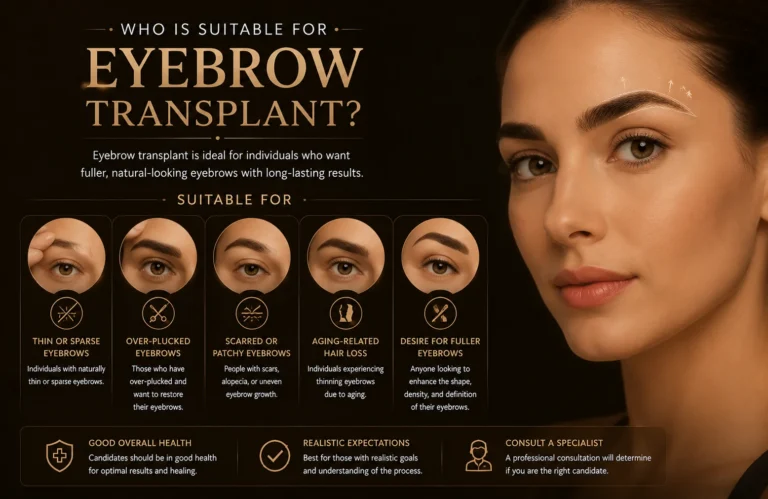
This procedure is highly versatile, making it an excellent option for both men and women. You are generally considered an ideal candidate if you have:
Over-Plucked or Over-Waxed Brows: Damaged hair follicles that refuse to grow back after years of grooming.
Genetic Thinning: Naturally sparse or barely-there eyebrow hairs from birth.
Scar Tissue: Bare patches caused by past injuries, facial burns, or surgical scars where hair no longer grows.
Medical Hair Loss: Trichotillomania (hair-pulling disorder) or stabilized systemic conditions that triggered brow shedding.
Good Donor Hair: Healthy, fine hair at the back of the scalp or behind the ears to serve as the donor source.
How Eyebrow Transplant Is Performed
Step 1: Customized Arch Design
The doctor maps out and draws the ideal eyebrow shape, alignment, and arch tailored to your unique facial proportions.
Step 2: Local Anesthesia
A numbing agent is administered to both the donor area (back of the head) and the brows to guarantee a pain-free experience.
Step 3: Graft Extraction
Using advanced Follicular Unit Extraction (FUE) or Direct Hair Implantation (DHI) micro-punches, individual single-hair follicles are delicately harvested.
Step 4: Implantation
The surgeon carefully creates micro-incisions in the brow region, strictly matching the natural 15-degree to 30-degree growth angle and direction of original eyebrow hairs, and inserts the grafts.
Eyebrow Transplant vs Microblading vs Tattoo
Choosing between permanent surgical restoration and cosmetic cosmetics depends on your budget, maintenance goals, and desire for realism.
| Feature | Eyebrow Hair Transplant | Microblading / Embroidery | Traditional Eyebrow Tattoo |
| Type | Minor Surgical Procedure | Semi-Permanent Ink Blade | Permanent Cosmetic Ink |
| Material Used | Your own real living hair | Organic pigment/ink | Industrial tattoo ink |
| Longevity | Permanent (Lifetime) | Fades in 1 to 2 years | Permanent (turns bluish/green) |
| Texture | 3D real volumetric hair | 2D drawn strokes on skin | Solid block of flat color |
| Maintenance | Occasional trimming required | Annual touch-ups needed | Hard to remove; needs laser |
Recovery and Healing Process
The downtime associated with an eyebrow hair transplant is minimal, allowing you to return to standard daily routines quickly.
Days 1–3: Tiny scabs will form around each transplanted hair graft. Minor swelling, redness, and bruising around the upper eyelids are completely normal.
Days 4–7: Swelling subsides, and the crusts will naturally flake off during gentle washing. Avoid scratching or picking at the scabs.
Week 2: The delicate grafts become securely anchored in place. You can resume light cardiovascular exercises, but shield your face from direct, heavy sun exposure.
Month 1 Onwards: As the hair begins its natural growth cycle, you will need to trim the brows with small grooming scissors every 1 to 2 weeks to keep them at your preferred length.
Risks and Side Effects
When performed by an experienced medical professional, an eyebrow transplant is an incredibly safe procedure. However, as with any clinical intervention, potential risks include:
Temporary Numbness or Soreness: Mild discomfort at the donor or recipient site that goes away within days.
Poor Graft Survival: If handled incorrectly, some hair follicles may fail to take root, resulting in minor asymmetry that requires a small touch-up.
Misdirected Hair Growth: If the surgeon does not angle the hairs precisely during implantation, a few hairs may grow outwards rather than flat against the skin.
Minor Infection or Folliculitis: Inflammation of the hair follicles, which is easily managed with prescribed antibiotic ointments.
💡 Pro-Tip: Always verify that your practitioner is a qualified medical doctor holding a valid LCP (Letter of Credentialing and Privileging) from the Ministry of Health Malaysia to avoid counterfeit operations and ensure total aesthetic safety.
Why Choose Us
Bespoke Brow Artistry
Every brow shape is meticulously custom-mapped based on your golden ratio, matching your exact facial structure and symmetry preferences.
Single-Hair Micro-Grafts
We exclusively harvest ultra-refined single hair follicles from the donor area to ensure seamless integration and a perfectly natural texture.
Natural Angle Direction
Grafts are strategically placed at a flat 15 to 30-degree angle, mimicking original eyebrow growth patterns so they lay flush against the skin.
Advanced Micro-FUE Tech
Using punches under 0.8mm ensures trace-free extraction from the back of the scalp, promising rapid healing and zero visible linear scarring.
Certified Clinical Care
Your procedure is performed inside a sterile, state-of-the-art theater strictly following international medical safety standards.
Dedicated Post-Op Support
Includes comprehensive follow-up checkups, specialized brow grooming guides, and growth serums to maximize follicle survival rates.
from our Eyebrow patients
"Incredible natural flow. The surgeon meticulously aligned the grafts to match my original brow direction."
"The customized arch design perfectly frames my eyes. No more filling them in with makeup every morning!"
"Highly precise work. The single-hair follicle extraction means my brows look perfectly soft and full."
"Completely painless experience. Local anesthesia kept me entirely comfortable throughout the arch creation."
"My patchy brows are fully restored. The 15-degree micro-incisions blend exactly like real brow hairs."
"Super fast recovery time and top-tier clinical care. My overall facial structure looks much more balanced."
"The doctor explained the specific brow mapping technique in great detail. I felt safe and confident."
"A total game-changer for over-plucked brows. The density and texture match my expectations completely."
"Incredible alignment along the tails of my brows. The donor area healed cleanly without visible tracking."
"The growth direction is flawless. It looks totally authentic and has permanently boosted my confidence."
"Extremely happy with my experience. Clean, modern clinic environment and excellent post-procedure tracking."
"The single hair implantation technique looks remarkably realistic. Worth every single cent."
"Transparent pricing, masterfully designed symmetric mapping, and premium clinical care throughout."
"Safe, meticulously executed, and backed by expert facial mapping logic. Truly life-changing results."
"After trying microblading for years, this permanent brow transplant is exactly the solution I needed."
EXCELLENT Based on 1282 reviews
 Posted on Google
 Low HendrickI did hairs implantation here. Very satisfied with the result so far on Day 8. Dr Glojas is very professional. Staff is very friendly, caring and patience. The treatment room is also very comfortable and huge TV with Netflix programs. 5 stars!Posted on Google
 Ooi Tze WeiVery good service and professionalPosted on Google
 noor amaliVery professionals & friendly doctor, staff. Good service. Strongly recommend herePosted on Google
 lip poh"I had an excellent hair transplant experience at Glojas. The lead physician, Dato' Jas, is highly skilled. His prices are very fair. The post-surgery aftercare has been outstanding. I still trust him with my ongoing hair treatments. He is highly recommended!"Posted on Google
 Emad IbrahimVery well done job, price was cheaper compared to other clinics, good price for a well done job. I did a frontal smart FUE transplant, and satisfied with the results.Posted on Google
 Khoo Zhe LunExcellent service and good result of hair transplantPosted on Google
 Kwenza
Trustindex verifies that the original source of the review is Google.
Extremely difficult and annoying to deal with. I gave up. Something is wrong with them for surePosted on Google naomi simsonMy life changes in just a single visit signed up for practitional procedure of hair-transplant journey to Glojas Specialist Clinic, utmost good faith. It was indeed an awesome rejuvenation, both in mindset as well as appearance. I was indeed impressed by the warm hospitality welcome by Ms Katherine at the very first I had stepped in the professional Specialist Clinic, well-known as Glojas. It literally released my tension and hesitation aroused beforehand in my miggling mind. Without any doubtness, crossed my heart, I must give Glojas a Super BIG thumb up and heartiest compliment based on the below 3 major hard-proven factors, on my 2nd hair-transplant experienced : 1. Dato Jas.'s Smart FUE technique is solely the winning and convincing key factor to my forehead and top hair transplantation. The neat and nicely arranged spaces between the hair folicurs look alike my nature born hair which indeed overrides and superceded the looseness of my 1st time hair-transplant which had been done else where clinic around town. My super Thanks to Dato. Jas, the trustworthy and warm kind Master in hair transplant expertise, are always super marking anchor here. 2. The well-trained and experienced hair technician, Ms Emma and her team-member are also making-up the 2nd successing elixir to my hair-transplant experience with Glojas Specialist Clinic. They are meticulous and responsible hand skills and attitude overrided my worries and recalcitrant innerself to an over-whelming happy clinical experience throughout the whole process of consultation, hair-transplantation and post-care procedures. 3. Never the least, I have compiled researchs by comparing among 5 clinics around town, in terms of services, manners, prices, location, reviews, briefing interviews, after-care procedure and word-of-mouths opinions beforehand. Among the expertism rendered, Glojas offers the most remarkable quality and more than reasonable price utmost good faith. Nevertheless, If you need any medical consultation in professional care-handling procedure regarding your inner-worries situation, do not hesitate to contact Glojas, you won't be ever regret, it shall be the smartest choice in your lifetime experience. Now or Never. Carpe Diem. Simson, Yap Weng Shen Kuala LumpurPosted on Google
 Rajendran KI’ve been a customer at Glojas for two years, and I’m very pleased with the results. I was able to improve my thinning hairline and maintain my hair growth without any surgical procedures. The team is professional, friendly, and supportive throughout the journey. A special thanks to Dato’ Dr. JasG for his expertise, guidance, and genuine care throughout my treatment. He was always helpful in explaining the process and recommending the best approach for my hair restoration journey. Highly recommended for anyone looking for effective non-surgical hair restoration treatments.Posted on Google
 Harsha SrinivasaAfter waiting nearly four years and making multiple visits to GLOJAS Specialist Clinic, I can confidently say that choosing them for my hair transplant was one of the best decisions I have ever made. From my very first consultation, Dato' Dr. JasG impressed me with his professionalism, expertise, and genuine passion for helping his patients. What stood out most was his consistency. Every time I visited over those four years, he brought the same energy, enthusiasm, positivity, and motivation. He never rushed me or pressured me into making a decision. Instead, he patiently answered my questions, guided me through the process, and gave me the confidence to proceed when the timing was right for me. That unwavering commitment and encouragement inspired me to return when I was finally ready, the hair transplant procedure performed by Prof. Dato' Dr. JasG exceeded my expectations. The entire experience was smooth, professional, and reassuring from start to finish. I would also like to extend my sincere appreciation to the entire GLOJAS team. Ms. Sheila, Ms.Emma , post implantation , support - Medical Assistants, The hospitality, care, warmth, and attention shown by every staff member made each visit a pleasant experience. The results have been very satisfying and I couldn't be happier. More importantly, they helped me regain a renewed sense of confidence. If you're considering a hair transplant, I highly recommend GLOJAS Specialist Clinic. You will be cared for by a team that genuinely puts patients first and delivers results with excellence. Wonderful experience, Glojas 🙏🏻⭐
FAQs About Eyebrow Hair Transplant in Malaysia
Yes, eyebrow transplants provide permanent results. The procedure uses hair follicles harvested from a donor area (usually the back of the scalp), which are genetically resistant to thinning. Once the transplanted follicles take root in their new location, they will continue to grow naturally for a lifetime.
Because the donor follicles come from your scalp, they will initially retain their original growth characteristics and grow longer than native eyebrow hairs. This means you will need to trim your new eyebrows once every week or two to maintain your desired length and shape. Over time, many patients notice the hairs gradually adapt to their new environment and slow down.
The treatment is highly comfortable and virtually painless. Before the procedure begins, a local anesthetic is applied to both the donor area and the eyebrows, completely numbing the treatment zones. Patients may feel a mild pinching sensation during the initial numbing injections, but the extraction and implantation phases are entirely pain-free.
An eyebrow transplant typically takes between 2 to 4 hours, depending on the level of density required. Recovery is quick, with most patients returning to light daily activities within 2 to 3 days. Tiny crusts will form around the individual grafts and naturally flake off within 7 to 10 days, leaving clean, completely healed skin.
Around 2 to 4 weeks after the procedure, the transplanted hairs will undergo a temporary shedding phase—this is a completely normal part of the follicle life cycle. New, permanent hair growth begins to emerge around month 3 or 4. You will see noticeable density improvements by month 6, with the full, final artistic shape completely visible between 10 to 12 months.