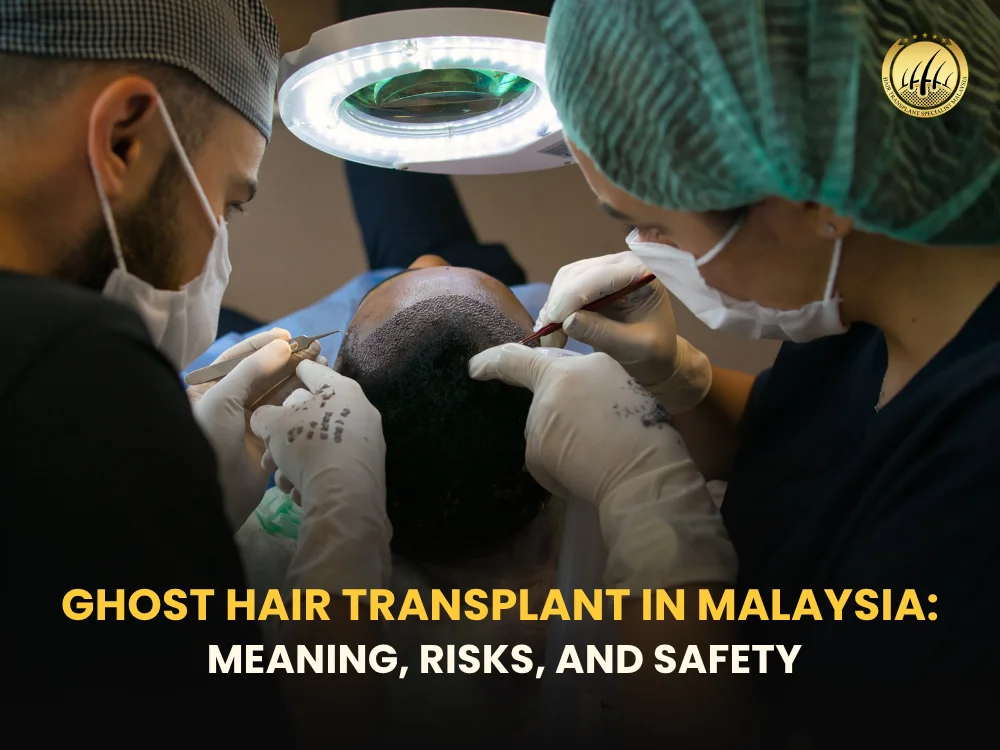
A ghost hair transplant refers to a deceptive medical procedure where a qualified surgeon consults with the patient, but unlicensed technicians perform the actual surgery—such as graft extraction and channel creation. The doctor vanishes or acts as a ghost during the critical stages, putting patient safety and surgical outcomes at risk.
Definition of Ghost Hair Transplantation
Ghost hair transplantation is an unethical practice in hair restoration surgery. In this scenario, a certified medical doctor completes the initial evaluation or hairline design, but delegate the surgical steps—including harvesting follicular units and making scalp incisions—entirely to non-medical technicians.
This practice misleads patients into believing they are receiving expert surgical care, when in reality, uncertified personnel are executing complex micro-surgical tasks.
Doctor vs Unlicensed Technician Roles in Hair Surgery
Understanding the legal and clinical boundary between a doctor and a technician is vital for your safety.
| Role Parameter | Certified Medical Doctor | Unlicensed Technician |
| Legal Status | Registered with Malaysian Medical Council (MMC) | Non-medical support staff |
| Surgical Incisions | Fully authorized to perform recipient site creation | Strictly prohibited by medical guidelines |
| Graft Extraction | Direct performance or active clinical supervision | Assistance only (e.g., sorting, loading grafts) |
| Complication Handling | Qualified to administer local anesthesia & manage emergencies | Unqualified to manage medical emergencies |
Signs and Red Flags of Ghost Hair Transplant Clinics
Identifying a ghost clinic early prevents severe surgical complications and poor esthetic results. Look out for these major red flags during your consultation.
Doctor Missing During the Procedure
If the doctor who conducted your consultation disappears as soon as local anesthesia is administered, you are likely experiencing a ghost hair transplant. Medical guidelines mandate that a certified surgeon remain in the operating room to execute or directly supervise every step of the hair restoration procedure.
Suspiciously Low Pricing
Unusually low prices—often advertised as “unlimited grafts” at a fraction of market rates—are a massive warning sign. Operating a legitimate medical facility with qualified doctors, proper sterilization, and licensed staff carries overhead costs. Discounted rates often mean the clinic cuts costs by relying entirely on low-wage, unlicensed technicians instead of a doctor.
Lack of Transparent Surgeon Credentials
Reputable clinics proudly display their doctor’s qualifications, registration numbers, and medical board certifications. Be wary of clinics that:
Use vague terms like “our expert clinical team” instead of naming the operating doctor.
Refuse to provide the surgeon’s MMC Registration details.
Prevent you from meeting the performing doctor prior to the day of surgery.
Risks of Ghost Hair Transplants
When unlicensed technicians perform invasive procedures, the likelihood of irreversible damage increases significantly.
Technician-Led Surgery ──> Poor Depth Control ──> Severe Follicular Trauma ──> Low Graft Survival
Severe Scalp Scarring and Infections
Surgical scalp incisions require precise knowledge of vascular anatomy and skin depth. Unlicensed technicians often harvest grafts too close together or insert punches too deeply, leading to:
Sub-dermal Necrosis: Skin tissue death caused by vascular compromise.
Cobblestone Scarring: Raised, irregular scars around implanted follicles.
Bacterial Infections: Poor aseptic techniques can trigger severe scalp sepsis.
Damaged Donor Area and Poor Graft Survival Rates
Over-harvesting in the donor zone (the back of the head) is a hallmark of inexperienced technician work. When hair follicles are extracted recklessly, the donor area becomes patchy and depleted, permanently destroying precious grafts. Furthermore, improper graft handling outside the body leads to high transection rates and poor survival.
Unnatural Hairline Results
Creating a natural hair restoration result demands artistic skill and anatomical precision. Technicians frequently make classic errors, such as placing multi-hair units along the front hairline, placing grafts at incorrect angles, or creating harsh, linear hairlines that look artificial.
Malaysia MOH Guidelines on Hair Transplants
The Malaysian Ministry of Health (MOH) enforces strict regulatory frameworks to protect patients from illegal medical practices.
MMC Doctor Registration Requirements
Every medical practitioner in Malaysia must hold a valid full registration and a current Annual Practising Certificate (APC) issued by the Malaysian Medical Council (MMC). It is illegal for anyone without an active MMC registration to perform invasive medical procedures in the country.
MOH Letter of Credentialing and Privileging (LCP) Rules
For aesthetic procedures—including surgical hair restoration—doctors must possess a specialized qualification. The MOH Aesthetic Medical Practice Guidelines require practitioners to obtain a Letter of Credentialing and Privileging (LCP).
Important Note: A doctor without an active LCP in Aesthetic Medical Practice is not legally cleared by KKM (Kementerian Kesihatan Malaysia) to perform hair transplant surgeries.
Restrictions on Unlicensed Technicians Performing Incisions
Under Malaysian law and MOH guidelines, clinical technicians are only permitted to assist doctors with non-invasive supportive tasks. Making skin incisions, punching donor sites, or inserting grafts into recipient sites are strictly defined as medical acts reserved exclusively for qualified doctors.
How to Avoid Ghost Hair Transplants in Malaysia
Protecting yourself requires proactive verification before booking any procedure.
Verifying Doctor MMC and LCP Status
Before signing any consent forms or making payments:
Search the official MMC MeRITS Portal to check if your doctor holds a valid Annual Practising Certificate.
Confirm that the practitioner holds an active LCP certification recognized by the Ministry of Health Malaysia for aesthetic practice.
Ensure the clinic itself is registered as a licensed medical clinic, not a beauty salon or medispa.
Essential Questions to Ask Before Surgery
Ask these critical questions during your pre-op consultation:
“Will you, the doctor, personally perform the graft extractions and surgical incisions?”
“May I see your MMC registration number and LCP certificate?”
“What specific tasks will technicians handle during my procedure?”
“What is your medical emergency plan if a complication occurs during surgery?”
Repairing a Ghost Hair Transplant
If you have suffered a botched procedure from an unlicensed clinic, corrective surgery may help restore your hair and scalp health.
Assessing Donor Area Damage
Repair begins with a thorough evaluation of the remaining donor zone. High-resolution trichoscopy assesses follicle density, scarring severity, and graft transection rates. If the occipital donor area is depleted due to technician over-harvesting, alternative options such as body hair extraction or scalp micropigmentation (SMP) may be considered.
Corrective Surgery Options
An experienced LCP-certified doctor can perform corrective procedures:
Graft Removal and Redistribution: Punching out unnaturally placed hairline grafts and re-implanting them at correct angles.
Scar Camouflage: Implanting new grafts directly into surgical scar tissue to hide patchy donor damage.
Density Enhancement: Carefully filling sparse areas without damaging surrounding native hair.
Clinical Experience Insight
In clinical practice, evaluating patients who have undergone technician-led surgeries frequently reveals extensive, hidden scarring under the scalp surface. Corrective hair restoration requires meticulous handling because scar tissue has reduced blood supply compared to healthy scalp tissue. Patients undergoing repair must understand that restoring damaged areas often requires a staged approach to safeguard graft survival.
Frequently Asked Questions
Is ghost hair transplant legal in Malaysia?
No, ghost hair transplant practices are illegal in Malaysia. Ministry of Health regulations state that surgical procedures and scalp incisions can only be performed by registered medical practitioners holding a valid Letter of Credentialing and Privileging (LCP).
Can technicians legally perform graft extraction or incisions in Malaysia?
No, technicians cannot legally perform graft extractions or recipient incisions in Malaysia. These are classified as invasive surgical acts reserved exclusively for qualified, MMC-registered medical doctors. Technicians may only assist with non-invasive supportive duties.
How to check if a hair transplant doctor is certified in Malaysia?
You can verify a doctor’s credentials online through the Malaysian Medical Council (MMC) MeRITS portal. Additionally, verify that the doctor holds an active LCP (Letter of Credentialing and Privileging) issued by the Ministry of Health Malaysia for aesthetic medical practice.
What are the main signs of donor over-harvesting?
Signs of donor over-harvesting include a “moth-eaten” or patchy appearance at the back of the head, visible scarring, and significant thinning in the permanent donor zone. This usually occurs when uncertified operators extract grafts too close together without evaluating donor density.
Can a botched ghost hair transplant be fixed?
Yes, a botched hair transplant can often be repaired by a certified aesthetic hair restoration doctor. Treatment options include punch-excision of misaligned hairline grafts, scar camouflage, and cautious redistribution of remaining donor hair.
If you suspect you have experienced a ghost hair transplant or want to ensure your procedure is performed by a certified doctor, schedule a consultation at Hair Transplant Malaysia Clinic for a professional medical assessment.